
Emergency Water Damage Restoration Near Me: What Minneapolis Homeowners Should Do First
The first 90 minutes after a water loss in a Minneapolis home decide whether the job costs $4,000 or $14,000. The steps are not complicated, but they are specific to our climate and our houses. And the single most expensive mistake we see is not waiting to call, it’s cranking the thermostat past 68°F to “dry things out faster,” which pushes warm, wet air into wall cavities and feeds mold before any equipment gets on site.
If you’d rather skip the reading and get a crew moving, call (888) 861-1852. A live dispatcher answers at 2 a.m., not a recording. If you want to know exactly what to do in the first hour and a half, here is the plan we give every Minneapolis homeowner.
What Minneapolis Homeowners Should Do in the First 90 Minutes
Here is the direct answer: shut off the water source, kill the power to affected areas if it is safe to reach the breaker, move what you can lift without hurting yourself, photograph everything before you move anything, and call a restoration company before you call your insurance carrier. That order matters. Most homeowners call the carrier first, spend 40 minutes on hold, and meanwhile water keeps traveling.
Water in Minneapolis behaves differently than water in Phoenix or Tampa. Our losses come from frozen pipes that thaw and dump gallons per minute, sump pumps that fail during spring snowmelt, ice dams backing water under shingles, and the occasional sewer backup in older south Minneapolis neighborhoods where clay lines have shifted. The source determines your safe first steps.
Here is the 90-minute sequence, adjusted for the three most common Minneapolis loss types:
- Find the water and stop it at the source. For a burst pipe, that means the main shutoff, usually in the basement near the water meter. Every adult in the house should know where this is before winter. For a sump overflow, unplug the pump if it is running dry or the float is stuck. Do not stand in water to do it. For roof or ice dam seepage, you cannot stop the water from inside, so move to step two and get a tarp call in.
- Cut power only if the panel is dry and reachable. If the panel is wet or you have to stand in water to reach it, do not touch it. Call an electrician or wait for the restoration crew. Water and a 200-amp panel do not mix, and this is the one area where we tell homeowners to do nothing rather than something.
- Photograph everything before you move anything. Wide shots of each room, close shots of the water line on drywall, the baseboards, the flooring seams, the items on the floor. Minnesota adjusters processing a claim without a site visit need to see the height the water reached and what it touched. Twenty photos taken now are worth more than fifty taken after you’ve mopped.
- Move what you can carry safely. Furniture, rugs, boxes, shoes. Waterlogged particleboard furniture falls apart when you lift it, so slide a board under it or leave it. Do not move a wet couch up stairs. That is how backs get thrown out at 3 a.m.
- Make the call. Every hour of standing water doubles the replacement scope. A restoration company that picks up live and can dispatch the same night is worth their number in your phone.
The two mistakes we see repeat every winter in Minneapolis: turning up the heat past 68°F, which accelerates evaporation into wall cavities, and opening windows “to air it out.” Opening windows in January lets in 10°F air with very low humidity, which freezes the surface water and stalls actual drying. Opening windows in July pulls in 70°F dew point air and adds moisture back into the space. Neither helps.
Set the thermostat to 68°F. Leave the windows closed. Let the equipment do the work.
Why You Call the Restoration Company Before Your Insurance Carrier
This is the piece of advice that catches most Minneapolis homeowners off guard, so let’s walk through it plainly. Your insurance policy has a section called “Duties After Loss.” It says you must take reasonable steps to prevent further damage. In Minnesota, with frozen pipe and snowmelt losses, that means extraction and drying started quickly, not Monday morning. Every hour water sits in flooring and wall cavities is an hour the adjuster can argue was preventable.
There is also a financial reason. A restoration company with direct insurance billing will document the loss, photograph it, moisture-map the affected areas, and send the scope and the daily readings to your carrier. You are not the messenger. You are not on hold at 2 a.m. trying to explain to a claims rep why the water went under the baseboards. The company and the carrier work it out, and you get a copy of everything.
The questions to ask on that first call, before you hang up:
- “Is this a live person or an answering service?” A service that makes you leave a message can’t deploy equipment faster than the speed of a callback, no matter what their website says.
- “When can a certified crew reach the property?” The answer should be measured in hours, not days. We answer the phone with a live dispatcher 24/7, and our crews are on the road the same visit.
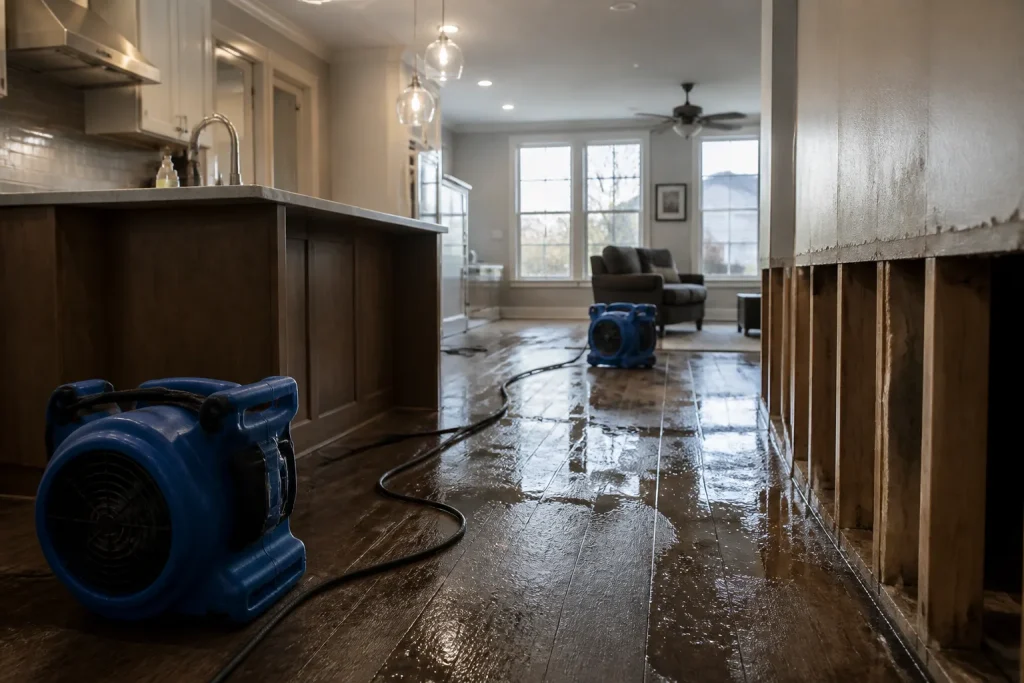
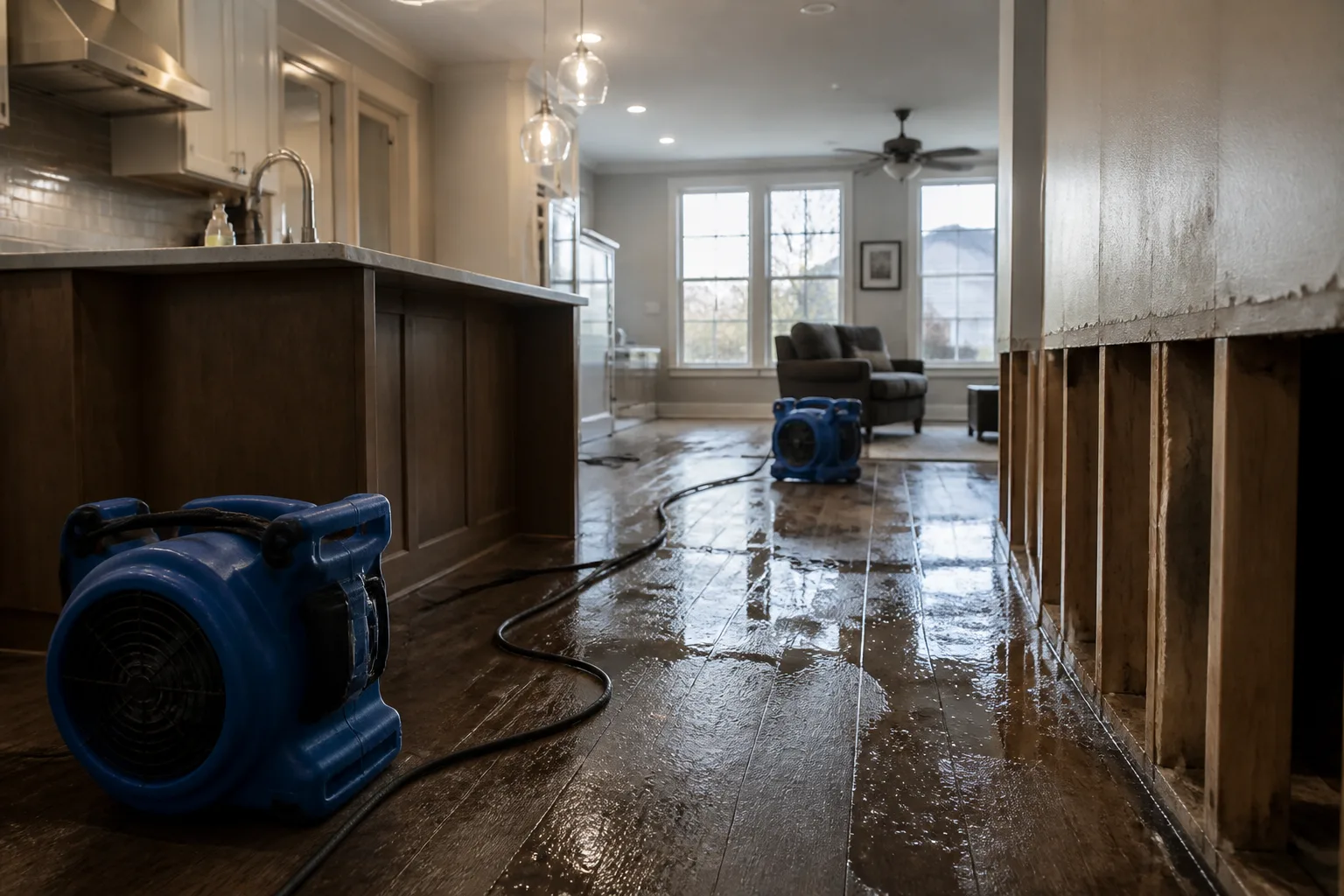
- “What equipment will you bring tonight?” If they can’t name a brand, they may not own it. We run Dri-Eaz, Phoenix, and XPOWER units, with Injectidry systems for the hidden cavity work, and we run the numbers to size the job before we load the truck.
- “Do you bill my insurance directly?” If the answer is vague, ask again. “Direct billing” has a specific meaning and it should be in writing. Ours is.
- “Will the same crew handle the rebuild?” Most companies extract and dry, then hand the rebuild to a subcontractor. Ours doesn’t. The same Floodline Restoration Co. of Minneapolis crew that reads the moisture map on day one is the crew that rebuilds the wall when the log says dry. You do not start over with a stranger in the middle of a claim.
And here is the answer to the question nobody asks until it’s too late: what does a legitimate 24-hour response look like? It looks like a background-checked, uniformed technician at your door before sunrise, a moisture map taken with professional meters, equipment placed and running before the first cup of coffee, and a written scope agreed before any walls come open. It does not look like a truck that parks outside while a sales rep walks the house for an hour. We built Floodline Restoration Co. of Minneapolis home around a dispatch board, not a sales desk. That is not a slogan. That is how the phone gets answered.
The Minneapolis-Specific Problems Most Articles Never Mention
Our housing stock is older than most of the country’s, and it behaves differently when it gets wet. Two construction features matter more than most homeowners realize.
The first is balloon framing. In homes built before about 1940, the wall studs often run continuous from foundation to attic with no fire blocking or horizontal plate between floors. That means water from a burst pipe on the second floor can travel down inside the wall cavity and pool on the first floor sill plate, three rooms away from the visible leak. By the time the drywall shows a stain, the damage has been moving for days. In neighborhoods like Longfellow, Powderhorn, and parts of Northeast where the housing stock runs 1920s and 1930s, we run moisture meters on the floor below any visible leak, every time. The water line on the wall is where we start, but it is rarely where the water stopped.
The second is the finished basement with a plastic vapor barrier behind the drywall. This is common in Minneapolis homes finished in the 1990s and 2000s. The barrier does its job keeping ground moisture out, but when a sump pump fails and two inches of water spread across the floor, that same barrier traps the moisture against the studs and insulation. The surface looks damp; the cavity behind it is soaked. We use Injectidry systems and negative air pressure to dry those cavities without tearing out every wall. It costs less than demolition and it works, but only if you catch it before the studs have been wet for a week.
One more thing that belongs in this section. We pulled a job out of a garage over by Nokomis last spring where a homeowner had spent two days running box fans and a dehumidifier from a big-box store. The floor looked dry. The moisture meter said 34% wood moisture content inside the wall base plates, which is roughly ten times the dry standard. He’d done everything the generic internet article told him to do. What he hadn’t been told is that a box fan moves air across a surface, it doesn’t pull moisture out of a sealed cavity.
If you are in the middle of this right now and not sure whether the fans are enough, they likely are not. Call us and we’ll tell you straight, before you spend another day wondering. That same call is how you get a free estimate, so there is no downside to making it.
What You Should Photograph and Document Before Anything Moves
Minnesota insurance adjusters deal with hundreds of freeze claims every winter and snowmelt claims every spring. They do not need a novel. They need specific, unedited photos that answer five questions:
- Where did the water come from? The burst pipe, the failed sump, the ice dam, the sewer cap. Photograph the source itself before it gets cut out or repaired.
- How high did it go? A photo of the water line on the drywall, or the watermark on furniture legs, shows the height. Include something for scale, like a tape measure or a can of paint.
- What did it touch? Baseboards, flooring seams, the bottom 12 inches of drywall, carpet pad if visible, any contents on the floor. The adjuster needs to see the material categories to approve the scope.
- What did you do in response? Photos of the water shutoff valve turned off, the breaker off if you killed power, the equipment running once the crew arrives. This shows the “reasonable steps to prevent further damage” your policy requires.
- What did you move? If you lifted a rug or pulled out a soaked runner, one photo of the floor underneath it before you move it tells a story no after-the-fact explanation can.
All of this happens before the first fan gets plugged in. A restoration company that knows Minnesota claims will do this documentation as part of the job, but your own photos, taken before anything changed, are your record. Do not rely on anyone else’s.
This is also where the direct-billing relationship pays off. We send the moisture map, the photo log, and the daily drying readings to your adjuster from day one, and we handle that communication directly. You get the copies. You never play phone tag with a carrier at 2 a.m. That is our job.
Related services in Minneapolis: if the water has been standing for more than 48 hours, you also need Mold Remediation in Minneapolis as part of the plan. If the loss started from a kitchen or wiring failure, see Fire & Smoke Damage Restoration in Minneapolis. And for the full scope of what the crew does, from first extraction to finished rebuild, start at Water Damage Restoration in Minneapolis.
What a Real 24-Hour Minneapolis Response Looks Like
Marketing pages all say the same thing: “24/7 emergency service.” The test is what happens when you actually call at 2 a.m.
A legitimate emergency response is a live person answering the phone, not a service that texts you a link. It is a dispatcher who can tell you which technician is on call and when they can reach your address, not “someone will call you back in the morning.” It is a crew that arrives with equipment on the truck, not a clipboard and a “we’ll get an estimate over to you.” Extraction should be running the same visit, not scheduled for the next day.
Here is how that plays out with us. Call (888) 861-1852 at any hour. A live dispatcher picks up. They ask the address, the source of water if you know it, and whether power is on. Then they tell you, in plain terms, when the crew will reach you. Not a window. A time. We show up in uniforms, with background-checked technicians certified to IICRC, RIA, and IFA standards. We run the moisture map before we open a single wall. We set the Dri-Eaz and Phoenix units and the XPOWER air movers. We check the electrical if water reached outlets. We document everything. And then we hand you a written scope of work and a drying plan, so you know what is happening and what it will cost before any construction begins.
That last part matters because the second biggest fear Minneapolis homeowners have, after the water spreading, is being oversold once a crew is inside the house. It is a known problem in this trade. The fix is simple and we think it should be standard everywhere: a written scope agreed before work starts. No surprises on the bill. No add-ons you didn’t approve. If it needs doing, it is in the scope first. Our 90-Day Done Right Promise, the Keystone Standard, is the same thing in writing, given at the end of the job: if it is not done right, we make it right, no arguing. That promise has Krafted right, Every time, Your home first, Standing behind it, behind it.
The Bottom Line
Here is the short version. In the first 90 minutes after a water loss in a Minneapolis home, you stop the water, kill the power only if it is safe, photograph everything, move only what you can lift safely, keep the heat at 68°F, leave the windows closed, and call a restoration company before your insurance carrier. The company should answer live, deploy the same visit, bill your carrier directly, and give you a written scope before any walls come open.
We will be there when we say. The line the water left is where we start. The job is not done until the moisture log says dry and the rebuild is finished by the same crew. You will have a square deal, no surprises on the bill, and the 90-Day Done Right Promise in writing.
If you are in Minneapolis and need help right now, call (888) 861-1852 for a free estimate. A live person answers. Always.
Frequently Asked Questions
Water damage restoration in Minneapolis typically runs between $4,000 and $14,000 depending on how long the water sat, how far it traveled, and whether walls or flooring need replacement. The biggest variable is time. A same-visit extraction and drying setup keeps most jobs under $6,000. Forty-eight hours of standing water pushes most jobs past $10,000 and into mold territory. The $89 Seasonal Tune-Up and $50 Off Any Repair Over $250 are always available, and we offer a Senior and Veteran 5% discount at all times. Call (888) 861-1852 for an exact quote, and the estimate is free.
In Minnesota, most homeowners policies cover sudden and accidental water damage, which includes burst pipes, ice dam leaks, and sump pump failures if you carry the riders. Sewer backup requires a separate endorsement on most policies. Gradual leaks and maintenance failures are typically not covered. The fast path to an accurate answer is direct insurance billing: Floodline Restoration Co. of Minneapolis documents the loss, files the scope with your carrier, and works directly with the adjuster so you are not left explaining water lines and moisture maps over the phone. Call (888) 861-1852 and we will explain what your specific situation likely triggers, before any work begins.
A real 24-hour emergency response means a live dispatcher answers your call at any hour and tells you when a background-checked, uniformed technician will arrive, measured in hours, not days. Our crews reach the job the same visit and extraction is running before the first assessment is complete. We do not answer with a recording, we do not put you in a queue, and we do not schedule a “next business day” appointment for a burst pipe at 1 a.m. Call (888) 861-1852 and you will speak to a human being. That is the first test of a legitimate emergency crew.
You can dry the surface. You cannot dry the wall cavities, the subfloor, or the insulation behind a vapor barrier without professional equipment and moisture mapping. In Minneapolis basements finished with vapor barriers, surface drying leaves hidden moisture trapped against the studs, and within days that becomes a mold problem. Box fans and a rental dehumidifier are better than nothing for the first few hours, but they are not a drying strategy. If the water line was above the baseboard or the water stood for more than an hour, call (888) 861-1852 for a free assessment. We would rather tell you it’s a small job than watch a small job become a $14,000 one.
Written by Curt Bowman, Owner at Floodline Restoration Co. of Minneapolis, serving Minneapolis since 2010.
Need Damage Restoration Help?
Call Floodline Restoration Co. of Minneapolis - licensed & insured, here with fast after-hours help in Minneapolis.
(888) 861-1852